McDonald's Made $10.4B in Rent in 2025. $6B in Royalties.
McDonald's collected $4.4 billion more in rent than royalties in FY2025. The architecture was incorporated in Delaware in 1956.
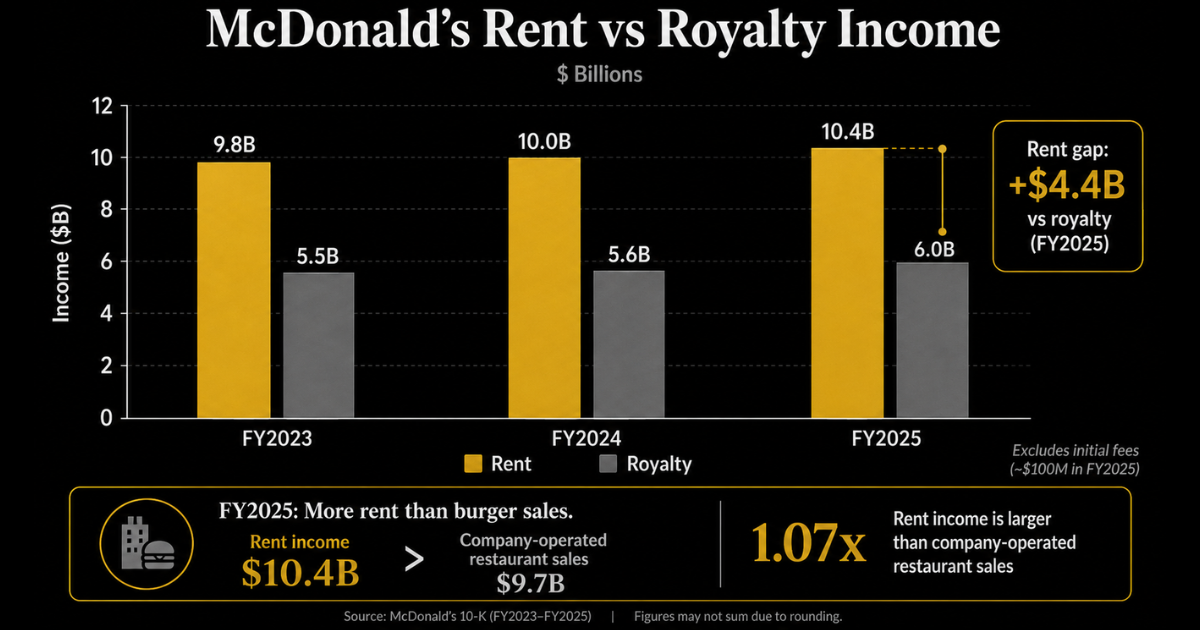
On a single page of McDonald’s FY2025 10-K, filed with the U.S. Securities and Exchange Commission on February 24, 2026, two numbers compress the whole company into one comparison. “Rents” reports $10.442 billion. The line directly below, “Royalties,” reports $6.018 billion. The difference comes to $4.424 billion, and it was sitting there the year before, and the year before that.
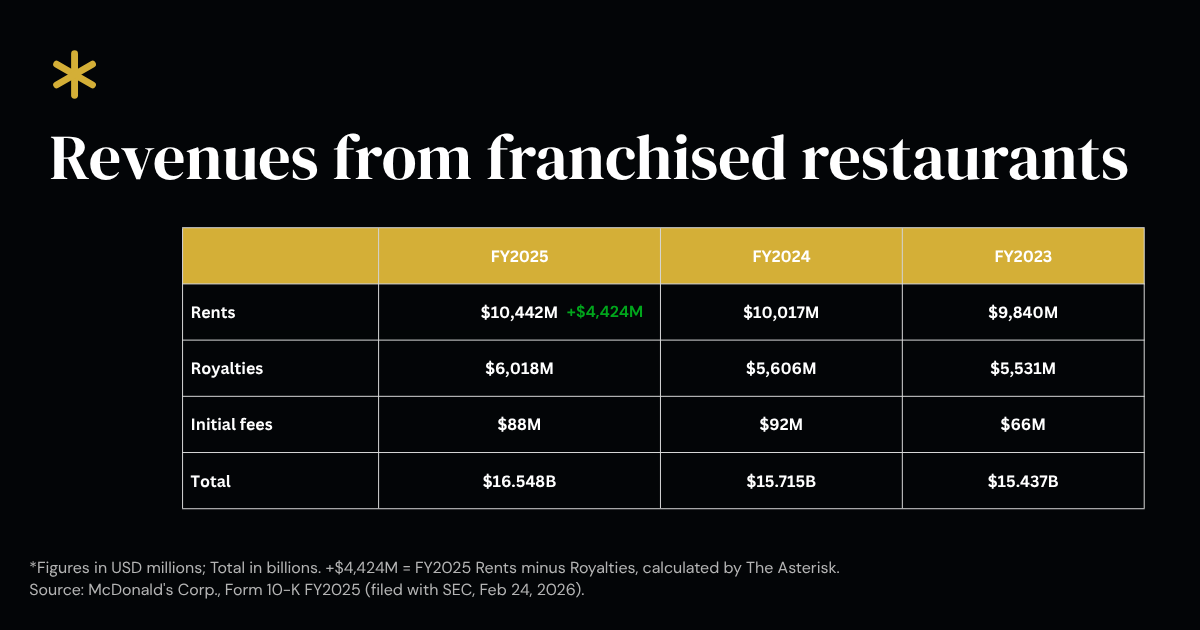
The line was not buried. It is the largest revenue sub-line on the franchised-restaurant disaggregation page, in plain dollars, in the same position it has occupied for years. The press release issued by McDonald’s on February 11, 2026 led with comparable sales and value-menu performance, not with rent. Read the 10-K the way the income statement is built, though, and the headline number is rent.
This is the story of how a corporate decision made in 1956 hardened into the largest revenue line in a public company that, by the Company’s own systemwide count, runs 45,356 restaurants. It is also the story of who pays for the structure, who collects from it, and what is happening, in present tense, inside the lease.
Every empire has one footnote. This one is in audited form, refiled every February.
What McDonald’s Tells You
McDonald’s Corporation operates 45,356 restaurants across more than 100 countries, and about 95 percent of them are owned and operated by independent franchisees rather than by the Company directly. That is the framing investor presentations lead with. A brand of dominant scale that consumes minimal capital because franchisees pay for the buildings, the labor, the food cost, and the storm damage when one of the parking-lot lampposts goes down in a hurricane. The 2025 Annual Report introduces the model as “the global leader in the quick-service restaurant industry,” anchors the year in same-store sales and value-platform execution, and only later, deep inside the financial-statements section, breaks revenue into its components.
The components break down like this. In fiscal year 2025, McDonald’s reported $26.885 billion of total revenue. Of that, $16.548 billion came from franchised restaurants, $9.690 billion came from the small subset of restaurants McDonald’s owns and operates itself, and the remaining $647 million from technology fees and brand-licensing arrangements. Franchisee revenue is therefore 62 percent of the top line. Of that franchisee revenue, rent was the single largest component.
The composition is not new. The same Company has disclosed it in approximately the same shape, with rent ahead of royalty, in each of the last three fiscal years (FY2023, FY2024, FY2025) the 10-K covers on this page. Pop business media has been calling it a “real estate empire” since at least the 2016 Motley Fool feature, the 2020 Strategy Story explainer, the 2022 Workweek piece, and the 2016 film The Founder. That framing is accurate as far as it goes. The detail underneath it is the part this investigation works through.
What the 10-K Actually Says
On a page titled “Revenues from franchised restaurants,” the filing disaggregates the franchisee line into four sub-lines. Rents: $10.442 billion. Royalties: $6.018 billion. Initial fees: $88 million. Total: $16.548 billion. The same page reports the comparison columns. In FY2024, rent was $10.017 billion against royalty of $5.606 billion. In FY2023, $9.840 billion against $5.531 billion. Rent is the larger of the two lines every year, and the spread between them keeps growing.
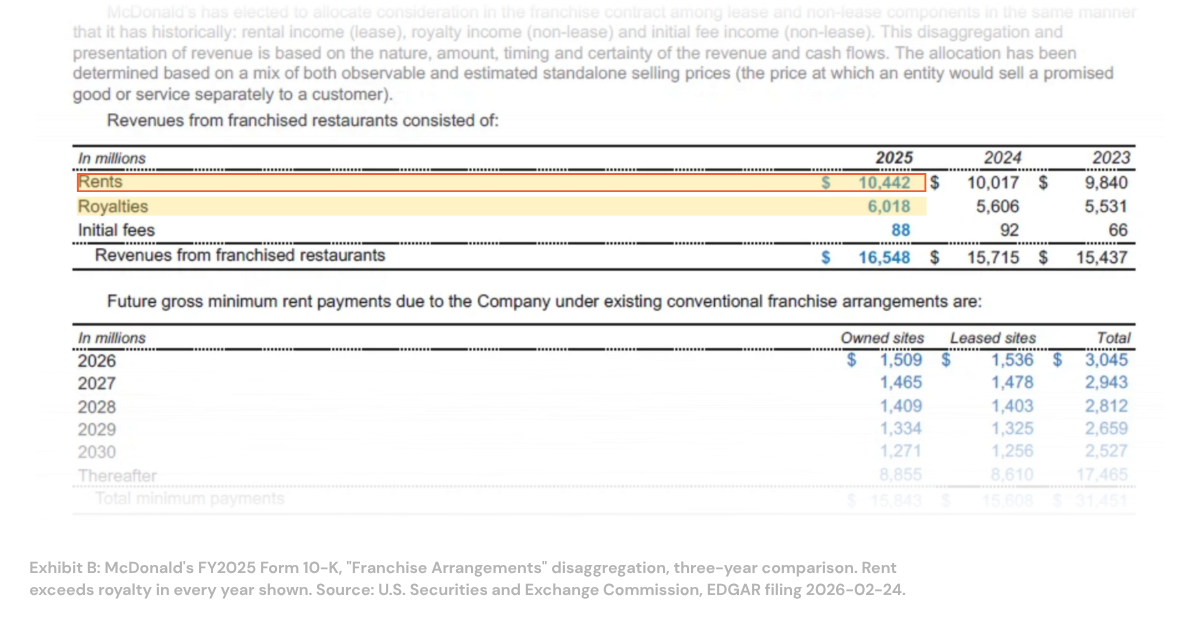
Net of cost, the picture gets sharper. The same 10-K reports franchised-restaurant occupancy expenses of $2.618 billion, the amount McDonald’s spent in 2025 maintaining the buildings it leases out: depreciation, the rent McDonald’s itself pays on leased land, real-estate taxes on the buildings it owns. Subtract that from rent income and the Company retained $7.824 billion of net rent margin in 2025. The franchisee paid the lease before opening the doors, and stayed on the hook for everything afterward.
Earlier in the same filing, in the Business Summary section the Company puts at the front of every 10-K, McDonald’s states the model in its own words. Verbatim: “The Company believes that ownership of real estate, combined with the co-investment by franchisees, enables it to achieve restaurant performance levels that are among the highest in the industry.” The line is unchanged from the FY2024 filing. It survives each disclosure cycle because the underlying assertion is structurally defensive. Ownership of real estate is the model.
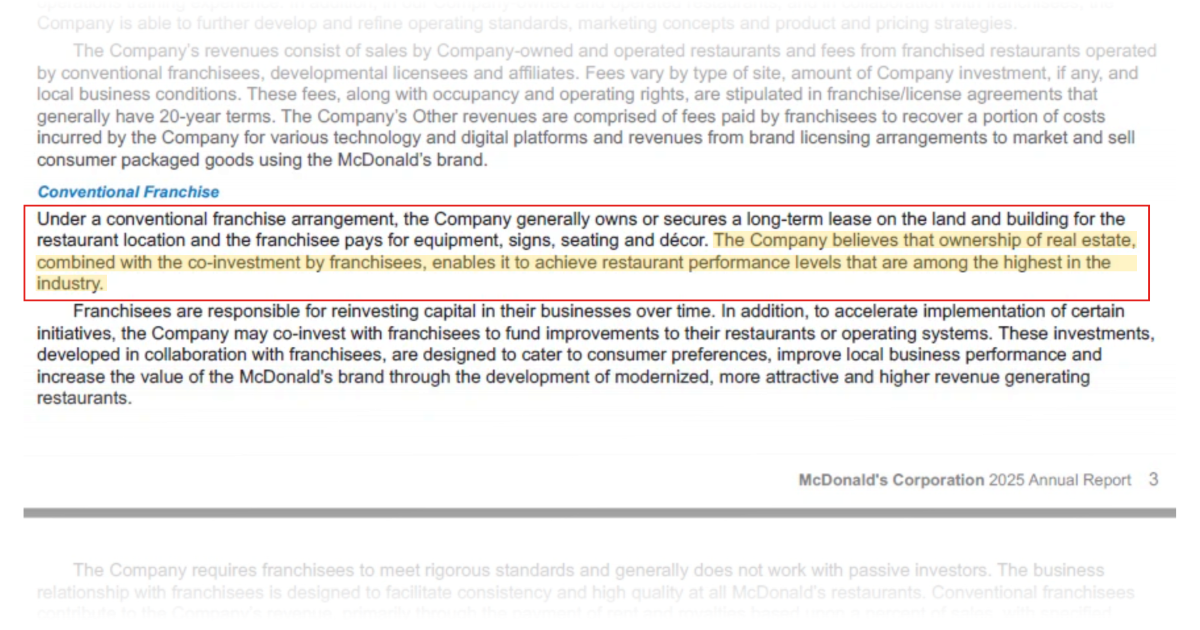
The 10-K is signed under penalty of false statements. The press release is not.
How It Got Built
The structure is older than the meme. It was set up in 1956, five years before McDonald’s bought out the McDonald brothers.
Harry J. Sonneborn arrived at the Company in 1955. He had been vice president of finance at Tastee-Freez, a soft-serve ice-cream franchise system. Ray Kroc, who had bought the McDonald brothers’ franchising rights the year before, was selling franchises at a flat fee plus a thin 1.9 percent royalty, and by John F. Love’s account, the per-franchise economics were thin enough that Kroc was operating on near-zero recurring margin per store. Each new franchise generated a one-time payment and a trickle of recurring revenue, and that was it. Sonneborn’s proposal was different. A separate company would buy or long-term-lease the land and the building, then sublease both to the franchisee at a markup. The franchisee would pay the markup as rent, on top of the royalty, and would also carry property tax, insurance, and maintenance directly.
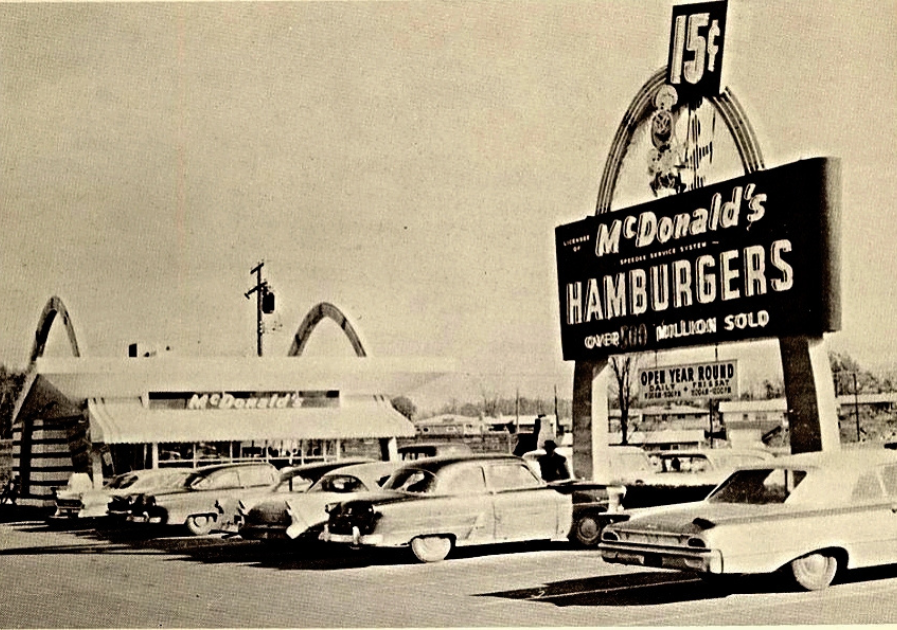
Photo by Wystan via Flickr (originally published in the 1961 Omega, Ann Arbor High School yearbook). Licensed under CC BY-SA 2.0. Modified from the source: re-encoded from PNG to AVIF; no edits to the image content.
Sonneborn set up the new entity in 1956 and called it Franchise Realty Corporation. Five years later, in 1961, Kroc bought out Dick and Mac McDonald for $2.7 million. Sonneborn was appointed McDonald’s first president and CEO in 1959 and served until his resignation in 1967. Around 1962, by Love’s account in the authorized history McDonald’s: Behind the Arches, Sonneborn told a group of securities analysts that McDonald’s was not technically in the food business, that it was in the real estate business, and that fifteen-cent hamburgers were simply the greatest producer of revenue from which tenants could pay their rent. The line is widely circulated and almost always traces back to Love. The specific Wall Street venue is not independently verifiable in primary investor materials, so what we have on the record is a secondhand account of a securities-analyst briefing in the early 1960s. The substance of what Sonneborn said has never been disputed by the Company. Only the staging is uncertain.
By 2026, Franchise Realty’s lineal descendants are two Delaware-domiciled subsidiaries named on McDonald’s FY2025 Exhibit 21: McDonald’s Real Estate Company (the U.S. portfolio) and McDonald’s International Property Company, Ltd. (the international portfolio). Both are wholly owned by McDonald’s Corporation. Neither shows up in the FY2025 press release or the 2025 Annual Report cover letter.
The Real Profit Engine
The franchisee pays rent calculated as the higher of two numbers: a fixed monthly minimum, or a percentage of monthly gross sales running, per Bloomberg Businessweek’s 2015 McRevolt investigation, from 8.5 percent to 15 percent. On top of that, a royalty of 4 percent of gross sales (announced September 22, 2023 to rise to 5 percent on newly opened U.S. and Canada restaurants effective January 1, 2024, the first such increase in nearly 30 years). On top of that, advertising contributions. On top of that, property tax, insurance, and maintenance on the building the franchisee does not own.
The land beneath the restaurant is held by one of the two Delaware subsidiaries above. Underneath them sit additional parcel-level entities that the Exhibit declines to identify by name. The Exhibit 21 reads, in its boilerplate, that McDonald’s USA, LLC has 59 wholly-owned subsidiaries that are not separately listed because they “do not constitute significant subsidiaries” under SEC Rule 1-02(w). The Exhibit describes those 59 as entities that “operate one or more McDonald’s restaurants” in the United States, language consistent with the operating businesses of company-operated stores rather than with the real-estate-holding stack itself. The parcel-level entities that actually hold the land and buildings under franchised restaurants are not enumerated in any public filing. There is no public list of every parcel McDonald’s owns, which means a researcher trying to map the portfolio store by store hits a wall right where the Exhibit ends.
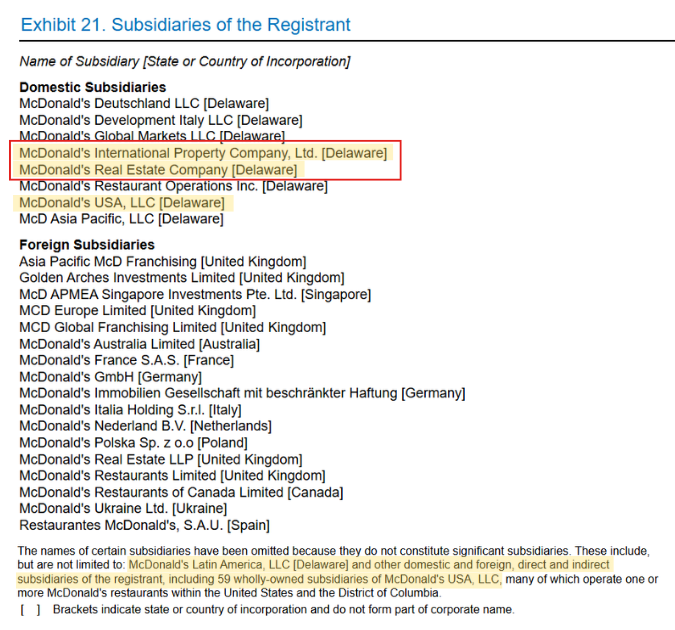
The Exhibit 21 closes with two structural data points the FY2025 press release does not carry. At year-end 2025, McDonald’s owned approximately 56 percent of the land and approximately 80 percent of the buildings for restaurants in its consolidated markets. The Company is the landlord of record for roughly four out of five buildings under restaurants flying its own logo, which is the ratio the model was designed to produce.
The franchisee voice on this structure is on the record. Bloomberg Businessweek’s 2015 McRevolt feature quoted operators describing escalating rent against flat sales, and characterized the relationship in terms closer to landlord-tenant than partner-partner. The National Owners Association, organized at a Tampa meeting in October 2018, represents roughly three-quarters of McDonald’s more than 1,600 U.S. franchisees per contemporaneous reporting by Reuters and CNBC, and has been making the same point in coordinated communications since.
Get the breakdown of next week’s investigation →
That was the model as it ran for most of the Company’s history. Adversarial enforcement began earlier than the public narrative usually concedes. The National Labor Relations Board General Counsel authorized a joint-employer complaint against McDonald’s USA on July 29, 2014. In May 2017, the Service Employees International Union called on Illinois and California regulators to investigate whether McDonald’s was adequately disclosing the formula it used to set franchisee rent. Neither action resolved against the Company, but both stayed in the public record.
On a Friday in September 2023, McDonald’s notified franchisees that the royalty rate would rise from 4 percent to 5 percent on newly opened U.S. and Canada restaurants effective January 1, 2024. The National Owners Association responded in writing the same week, saying the “self-proclaimed rights” McDonald’s possessed “do not establish that the changes are the right thing to do for the business, the relationship, or the future of our Brand.” The Association had earlier in 2023 reported that per-restaurant cash flow had declined approximately $100,000 in 2022, a figure it reiterated alongside its September response.
The Comparison You Weren’t Expecting
The single most informative table in the filing is not the rent line in isolation. It is the rent line set beside the company-owned restaurant business.
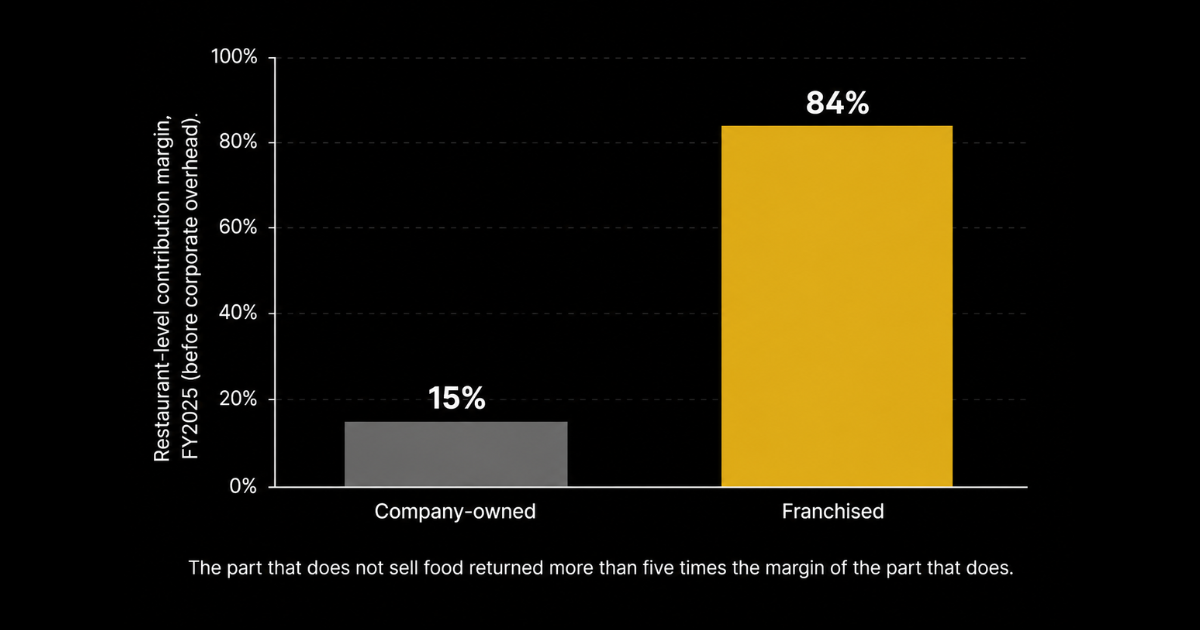
McDonald’s owns and operates 5 percent of its restaurants directly. That part of the business generated $9.690 billion in sales in 2025 and cost $8.268 billion to run, leaving a restaurant-level contribution margin of approximately $1.4 billion, or roughly 15 percent of sales, before any corporate overhead. The franchised business, in which McDonald’s owns no kitchens, employs no cooks, and never serves a single customer, generated approximately $13.9 billion of contribution margin on $16.5 billion of revenue. The contribution margin on the franchised business was approximately 84 percent. The half of the business that does not sell food returned more than five times the margin rate of the half that does.
The balance sheet describes the same asymmetry from the other direction. Property and equipment at cost on the December 31, 2025 balance sheet totaled $49.290 billion. Land alone accounted for $8.169 billion. Buildings on owned land added $22.202 billion. Buildings on leased land added $15.506 billion. Real estate, in total, was approximately 93 percent of every dollar McDonald’s has ever invested in physical assets. The remaining 7 percent is equipment, signs, seating, and the fryers and ovens that produce the food a McDonald’s franchisee actually sells.
The pop business meme that “McDonald’s owns 99 percent of its assets in real estate” is wrong. The actual figure is approximately 93 percent of property and equipment, or approximately 77 percent of total assets ($59.515 billion at year-end 2025). The meme is sloppy; the point survives.
The Standard Lease, Applied Unequally
The lease formula has been the subject of two distinct legal challenges since 2019. The first concerns how rent relief, growth opportunities, location assignment, and inspection enforcement, all discretionary inside the standard franchise relationship, were deployed in practice.
On August 31, 2020, 52 former Black McDonald’s franchisees filed Crawford v. McDonald’s USA, LLC in the Northern District of Illinois, case number 1:20-cv-05132. Lead-named plaintiff Christine Crawford and her mother Delores Crawford, the matriarch who became a franchisee in 1988, were South Carolina residents operating in McDonald’s Atlanta Region. Between 2010 and 2018, the Crawfords owned and lost seven stores before being forced out of the system.
The Crawford complaint does not allege a single-store rent dispute. It alleges a pattern. The plaintiffs’ average annual sales were $2 million, more than $700,000 under McDonald’s national average of $2.7 million between 2011 and 2016 and $2.9 million in 2019. The cash flow gap between Black and white McDonald’s franchisees more than tripled between 2010 and 2019, per data the complaint attributes to the National Black McDonald’s Operators Association. The number of Black franchisees in the system fell from 377 in 1998 to fewer than 200 by 2020, while the total number of McDonald’s franchised restaurants more than doubled in the same period. The plaintiffs collectively lost approximately 200 stores, with damages averaging $4 million to $5 million per store.
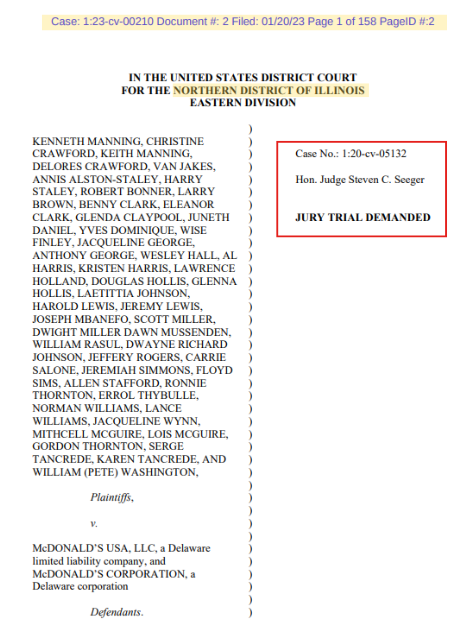
The complaint enumerates specific mechanisms inside the standard franchise relationship that, the plaintiffs allege, were applied unequally on the basis of race: steering to high-cost low-volume locations, denial of permanent rent relief routinely provided to white franchisees, exclusion from the Next Generation legacy program, exclusion from growth opportunities to higher-volume stores, escalated inspections and harsher grading in business reviews, and final approval over qualified buyers at the point of exit. As precedent, the complaint reaches back to the 1984 dispute publicly aired by Charles Griffis, a Black Los Angeles franchisee whose case put on the public record the disparity in security and operating costs McDonald’s required of Black-neighborhood franchisees compared to those imposed on operators in white neighborhoods. The pattern, if the complaint is right, has documented antecedents at least four decades old.
The 2020 Crawford action was dismissed on McDonald’s motion on September 28, 2022, with leave to amend. The plaintiffs split into two amended complaints before the same judge, Steven C. Seeger. Crawford plaintiffs filed inside the original case at Document #79 on December 16, 2022. The Manning group filed separately as a new docket, 1:23-cv-00210, on January 13, 2023, with more than 45 named plaintiffs at filing. Both cases remain active.
The second legal challenge to how the standard lease was applied concerns workers, not franchisees. In November 2019, McDonald’s settled a California wage-theft class action covering approximately 38,000 cooks and cashiers at company-operated restaurants for $26 million. Divided across the class, the average recovery was under seven hundred dollars per worker.
What McDonald’s Said
McDonald’s has defended the model, in writing and on the record, in several distinct contexts. The Company has not been separately contacted for this article; the positions cited below are publicly documented in SEC filings, court records, and on-the-record statements to franchise-trade reporters.
In the FY2025 Business Summary cited above, the Company asserts that ownership of real estate, combined with co-investment by franchisees, drives restaurant performance among the highest in the industry. At the International Franchise Association convention in Las Vegas on February 27, 2023, Chief Executive Officer Chris Kempczinski told attendees that the Company’s “business model is under attack,” directing the comment at proposed state and federal franchise regulations. In an April 9, 2020 letter to the National Owners Association, after the franchisee body had asked for pandemic-era rent abatement, U.S. President Joe Erlinger wrote that if that was how the NOA sought to define its relationship with McDonald’s, then in reality there was no relationship, and that he was “extremely disappointed and disheartened” by it. In a September 2025 CNBC interview, Kempczinski acknowledged that franchisee cash flow was “probably off maybe 10% from where our franchisees had all-time cashflows” and said McDonald’s franchisees were doing “better than our competitors.”
Read in sequence, the four statements describe a single contractual relationship. The Company is the landlord. The franchisee is the tenant. The contract is the lease.
What Changed When the Hidden Model Showed
Three events from 2025 sit inside the same two-year sequence that includes the royalty hike.
In August 2025, the National Owners Association issued a statement accusing the Company of “intimidation tactics” against franchisees who had raised concerns about new operating standards, inspections, and ownership-transfer approvals. The Association had by then retained outside counsel and was preparing comment on the U.S. Federal Trade Commission’s request for information on franchise business practices. In September 2025, on CNBC’s Squawk Box, Kempczinski publicly confirmed that operator cash flow was down approximately 10 percent from post-pandemic highs and worse in California. On December 8, 2025, McDonald’s senior vice president of global franchising, development, and delivery Andrew Gregory issued a memo to franchisees announcing that, effective January 1, 2026, the Company would begin assessing franchisees globally on how well their pricing decisions delivered value, with non-compliance potentially triggering penalties or termination of franchise rights.
Each event is independently substantiated. Stacked, they describe enforcement of the standard franchise relationship tightening rather than loosening across the last two years. That directional reading is editorial, not from the dossier.
The same Company that settled the California wage-theft class for $26 million in November 2019 (under $700 per worker) settled its lawsuit against former Chief Executive Officer Steve Easterbrook on December 16, 2021 for cash and equity worth more than $105 million, which coverage at the time described as one of the largest executive-compensation clawbacks in U.S. history. In fiscal year 2025, the Company returned approximately $7.1 billion to shareholders, including $2.0 billion in treasury-stock repurchases (6.7 million shares), with the balance in common-stock dividends.
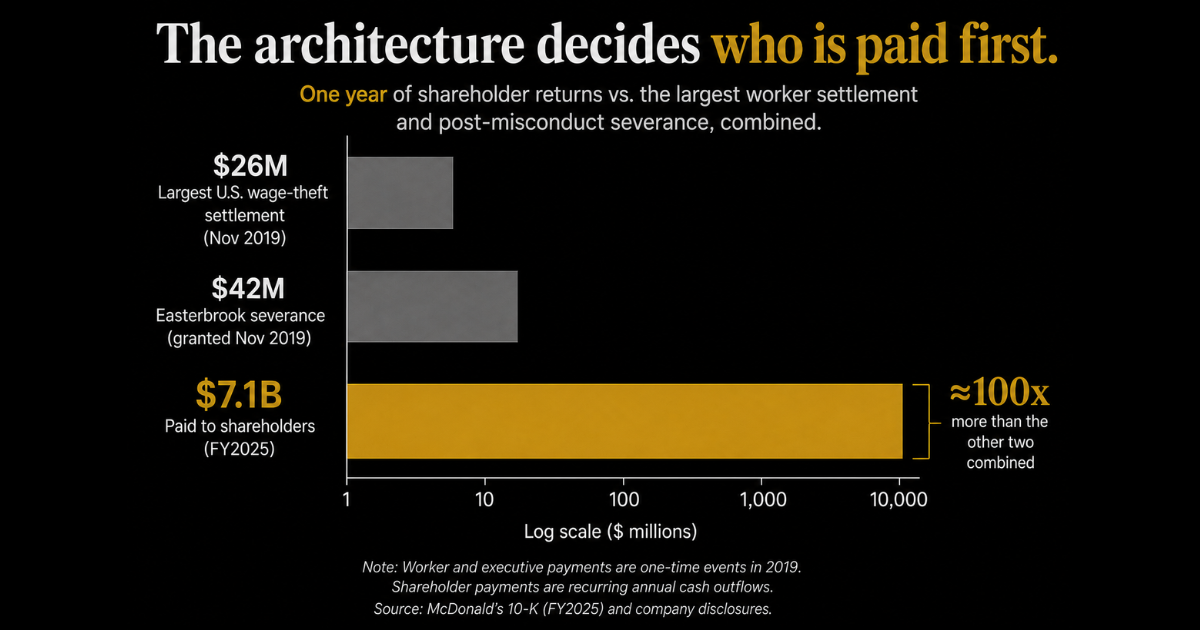
The architecture decides who is paid first.
Every Empire Has Its Footnote
The line in the 10-K has been sitting in the income statement, on the same disaggregation page, in the same position, for at least the three fiscal years the FY2025 filing discloses. The page is open. Anyone can read it.
What the page describes was built in 1956 by a finance executive who, by Love’s account, told securities analysts the formula out loud while it was still a fresh idea. Sixty years later, the formula is running in audited form, generating numbers in nine and ten figures, and being contested on three fronts at once: two amended complaints in the Northern District of Illinois, one franchise-association organizing drive, and one government settlement column two orders of magnitude smaller than the dividend column.
The empire is real, the earnings are real, the growth is real. The asterisk is on the opening pages of the Business Summary, in plain English, every February. Every empire has one.*
The Number to Watch
McDonald’s must file its FY2026 10-K, with the next Exhibit 21 corporate-subsidiary list, approximately late February 2027. The number to watch is whether the count of subsidiaries underneath McDonald’s USA, LLC grows, shrinks, or holds at 59. The press release will not flag it. The Exhibit 21 will. More from The Asterisk’s investigative catalog.
Every empire has one.*